
WONACH SUCHST DU?

The fundamental difference between ball screws and trapezoidal screws lies in their operating principles: ball screws rely on "rolling friction," whereas trapezoidal screws rely on "sliding friction."
This underlying difference directly dictates the significant disparities in their performance, cost, and application scenarios.
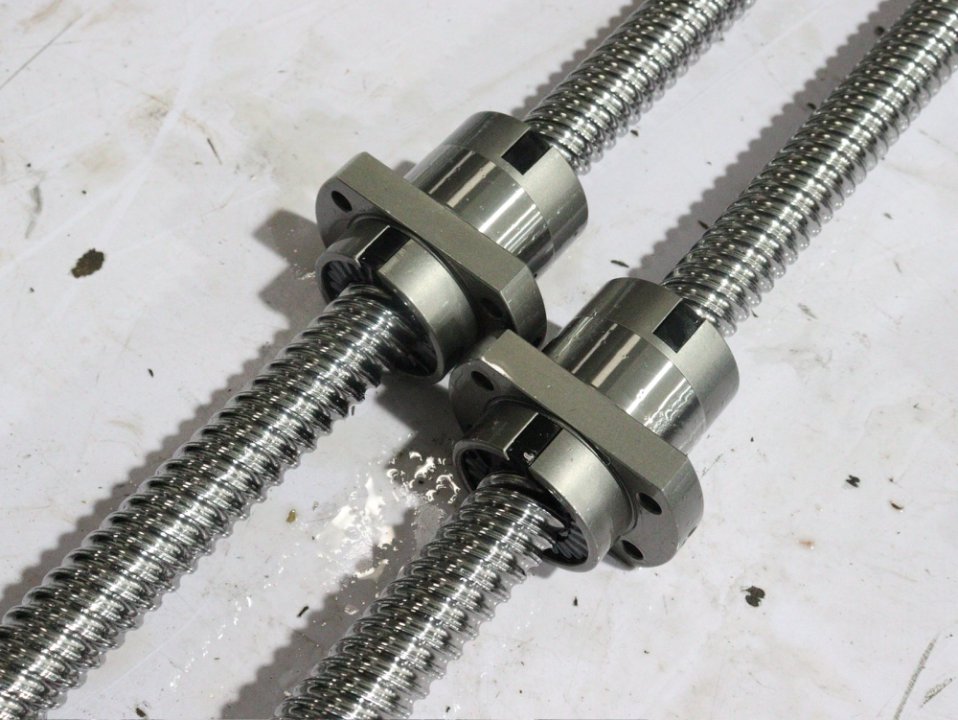
Core Performance Comparison Table
| Comparison Criteria | Ball screw | Trapezoidal lead screw |
| Type of Friction | Rolling friction (recirculating steel balls within the nut) | Sliding friction (direct contact between thread surfaces) |
| Transmission Efficiency | Extremely high | Relatively low |
| Transmission Precision | High (enables micron-level positioning and backlash elimination) | Low to medium (inherent backlash, prone to wear) |
| Self-locking Capability | No self-locking capability (requires a brake for vertical applications) | Typically self-locking (prevents sliding down when the lead angle is small) |
| Operating Speed/Frequency | Suitable for high-speed, high-frequency, continuous operation | Suitable for low-speed, low-frequency, intermittent operation |
| Service Life and Maintenance | Long service life and minimal wear, but requires effective lubrication and dust protection | Wears relatively quickly, but resistant to contamination, simple structure, low maintenance |
| Operating Noise | Low (primarily the sound of steel balls colliding) | Low to medium (may produce noise during dry friction) |
| Cost and Price | High (precision manufacturing; high system cost) | Low (simple structure, cost-effective) |
How do you choose the right type based on actual needs?
In practical mechanical design or equipment selection, the choice can be made based on the following key criteria:
1. Scenarios for choosing "Ball Screws"
High precision and high repeatability: e.g., CNC machine tools, laser cutting machines, semiconductor packaging equipment, automated robots, etc.
High-frequency, continuous motion: Equipment operates uninterrupted for long periods daily, requiring high transmission efficiency and effective heat control.
High-speed movement: Linear axes requiring rapid response and high-speed motor drive.
2. Scenarios for choosing "Trapezoidal Lead Screws"
Limited budget/cost sensitivity: Low requirements for positioning accuracy (e.g., millimeter-level) and a focus on high cost-effectiveness.
Need for vertical self-locking: e.g., hand-cranked lifting platforms, medical bed lifts, simple valve actuators, etc. The nut does not slide down on its own during power outages or when the motor is not holding torque (Note: large-lead trapezoidal screws may lose self-locking capability).
Low-frequency, short-stroke use: e.g., adjustment mechanisms, manual positioning fixtures, or mechanisms that operate only occasionally.
Harsh operating environments: In environments with high dust levels or a lack of regular lubrication and maintenance, trapezoidal screws (using engineering plastic or bronze nuts) offer greater tolerance.
Bitte lesen Sie weiter, bleiben Sie auf dem Laufenden, abonnieren Sie uns und wir heißen Sie herzlich willkommen, uns Ihre Meinung mitzuteilen.


 IPv6-Netzwerk unterstützt

 MELDEN SIE SICH FÜR UNSEREN NEWSLETTER AN